


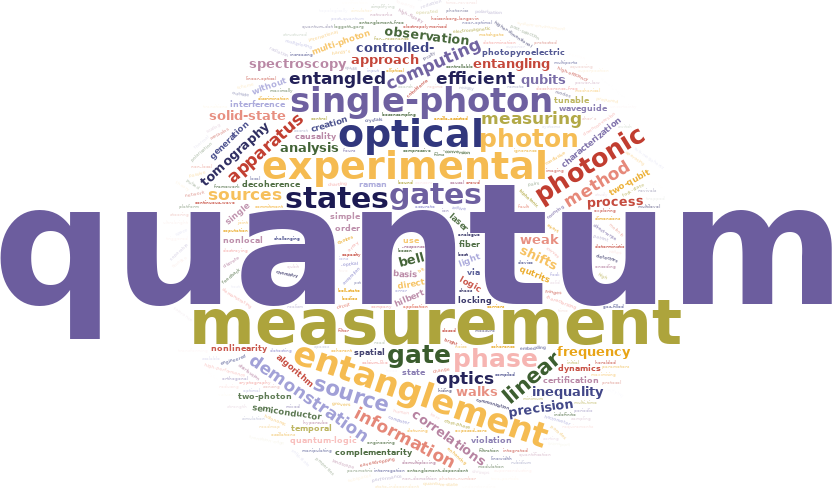
Our research includes quantum foundations, quantum information, quantum technology and quantum engineering, quantum optics and quantum photonics, neuromorphic computing, nonlinear optics, and biophysics. Collating some of our papers we get the following word cloud:
Below are abstracts from some of our funded grants from over the years. Please enjoy the unbridled enthusiasm, and apologies for the jargon!
QUANTUM LINK VERIFICATION
UQ Exeter Institute Strategic Grant, 2025–27. In this project, we propose Quantum Link Verification (QLV), a novel, robust, yet not-explored solution for the long-term challenge of physically securing communication links. QLV combines the physically guaranteed security of quantum mechanics to verify the integrity of the link, allowing the actual message to be transmitted with existing technologies and bandwidths. In QLV, we overlay a quantum and classical telecommunication signal through the same fibre, enabling the continuous verification of the integrity of the network. The potential increase in performance is dramatic, as the actual data transmission is done at standard telecom rates, which far outperforms any state-of-the-art QKD system. The advantages of QLV are that:
- QLV can be incorporated into fibre or free-space optical communication networks.
- QLV overlays existing infrastructure, requiring no modifications.
- QLV has a negligible impact on current data transmission speeds and bandwidth.
CENTRE IN CURRENT AND EMERGENT QUANTUM TECHNOLOGIES (QuTech)
Australian Research Council Industrial Transformation Training Centre, 2025–30. This Training Centre aims to provide technical and leadership skills to our next generation of quantum technology leaders, advancing Australia's presence in current quantum technologies, and innovating and implementing new ones. In close collaboration with universities, Defence, and industry members, and with strategic guidance, the Centre will address the Defence and Enabling Technologies needed in Australia as these technologies grow world-wide at an accelerated pace. The outcomes of training future quantum technology leaders in areas touching engineering, physics and biology are the broadly shaping of the high-technology landscape in Australia as the quantum economy expands, and provide protection for our economic and political future.

ENERGY-EFFICIENT ARTIFICIAL INTELLIGENCE USING QUANTUM TECHNOLOGIES
Australian Research Council Laureate Fellowship, 2022–26. Artificial intelligence (AI) is transforming society but standard technologies come with significant hidden costs: training even a single, common, learning model can emit 5 times more carbon dioxide than the lifetime emissions of the average car. This Fellowship aims to develop artificial intelligence platforms using Australia's significant investment in quantum technologies to bypass traditional approaches to AI. The expected outcomes are neuromorphic computers that operate efficiently—with low-energy cost—and rapidly—achieving speeds impossible with conventional electronic approaches. The anticipated benefits are transformative technologies for AI, new applications across society, and new tools for exploring brain function and cognition.
CENTRE FOR ENGINEERED QUANTUM SYSTEMS (EQUS)
ARC Centre of Excellence, 2018–25. The ARC Centre of Excellence for Engineered Quantum Systems, EQuS2, will build sophisticated quantum machines to harness the quantum world for practical applications. Our Centre will pioneer the designer quantum materials, quantum engines, and quantum imaging systems at the heart of these machines. We will solve the most challenging research problems at the interface of basic quantum physics and engineering, and work with partners in industry to translate these research discoveries into practical applications and devices. Our capacity- building programs will train a new generation of scientists in cutting-edge fundamental research, innovation, and entrepreneurialism, and ultimately have a major impact on Australia's high-tech economy.

THE CAUSAL POWER OF INFORMATION IN A QUANTUM WORLD
Templeton World Charity Foundation, 2014–17. The scientific method is grounded on the concept of causation and intelligent agency. In this project, we will give a philosophically coherent, theoretically justified and experimentally validated defence of the thesis that to be a cause, information must be embodied. The project will address big questions including: Does information have causal power? How does one understand causal relations in a quantum world? Are there new quantum architectures for control, based on automated intelligent agents (IA) with access to the full power of quantum information processing?
The concept of information as causal has received little attention in the philosophical literature on causation. Given the advances in quantum information, it is well time this topic was explored in detail. One of the unique features of this proposal is the real time interaction between philosophers and theoretical and experimental physicists.
CENTRE FOR ENGINEERED QUANTUM SYSTEMS (EQuS)
ARC Centre of Excellence, 2011–17. The future of technology lies in controlling the quantum world. The ARC Centre of Excellence for Engineered Quantum Systems (EQuS) will deliver the building blocks of future quantum technologies and, critically, ensure Australian primacy in this endeavour. Three strategic research programs will target Quantum Measurement and Control; Synthetic Quantum Systems and Simulation; and Quantum-Enabled Sensors and Metrology. Within these programs, our Centre will exploit the deepest principles and resources of quantum physics to solve specific problems in engineering, chemistry biology and medicine, stimulating the Australian scientific and engineering communities to exploit (and benefit from) transformative quantum devices.

CENTRE FOR QUANTUM COMPUTATION AND COMMUNICATION TECHNOLOGY (CQC2T)
ARC Centre of Excellence, 2011–17. The Centre for Quantum Computation and Communication Technology will coordinate a large team of Australian researchers in an intensive mission. Our aim is to integrate a radical and uniquely powerful Australian computing technology with an ultra-secure Australian communications technology. Our success will drive global productivity gains in information processing and ensure that Australians own the pivotal underpinning intellectual property. Our technologies will provide Australia and its allies with the world's most secure information networks. Our discoveries will place Australia unequivocally at the very forefront of global research in quantum physics.

BIOMOLECULAR OPTOELECTRONIC MATERIALS AND DEVICES
ARC Discovery Project 2008–10. The melanins are the molecules in our skin, eyes and hair that provide colour and protection from the sun. In addition to being important bio-molecules, they have properties which make them useful for high tech applications especially in electronics and optoelectronics. Unfortunately, our current understanding of these fascinating materials is poor. In our project we aim to solve this limiting problem. We will develop new science to explain their behaviour, and use this knowledge to create bio-compatible hi-tech materials and devices. We anticipate significant benefits from the perspectives of basic science and utilisation of biomaterials for new green technologies.
INTEGRATED QUANTUM PHOTONICS
ARC Federation Fellowship 2006–11. The key physical technological advances of this century will be due to quantum technologies which exploit the unique properties of entanglement, a phenomenon with no everyday analogue. Understanding and applying entanglement is one of the great challenges in Physics, as is finding an experimental path to large-scale devices. This Fellowship will launch a major new initiative to address these challenges by developing optical quantum technology that integrates many photons to form powerful quantum devices. This exploits the key recent demonstration of few-particle entangling devices. By providing a route for industrialisation, this project will extend Australia's early lead in quantum technology so as to maximise the benefits to Australia.
QUANTUM HOLOGRAPHY: ENCODING QUANTUM INFORMATION IN OPTICAL PATTERNS
University of Queensland Foundation Research Excellence Award 2005. Quantum information applies concepts from quantum mechanics to information tasks such as communication and computation. The fundamental units of quantum information are multi-level quantum systems known as qudits. To date, most experiments have realised only their simplest two-level incarnation, the qubit. In principle, tasks such as quantum cryptography, secret sharing, and dense coding, all benefit from using qudits larger than the qubit. We propose a scheme to realise qudits in practice by encoding them into optical patterns (the transverse spatial modes of the field); to manipulate these qudits via holographic techniques; and to make entangling gates using linear optics and measurement. We will explore a range of quantum phenomena and information protocols that are only accessible with qudits.
CONTROLLING QUANTUM TECHNOLOGIES
ARC Discovery Project 2005–07. We are on the verge of a Quantum Technology revolution, where quantum physics is driving otherwise impossible technological advances. To date, quantum technologies have made little use of the monitoring and feedback that is ubiquitous in everyday industry, keeping planes in the air and robots welding accurately. This project is concerned with learning to actively control finite-size quantum systems and processes, by studying the control of photons—single particles of light. Our experimental and theoretical research will have immediate application to burgeoning technologies—such as absolutely secure quantum communication and ultrahigh precision measurement—and contribute to the development of broad-ranging quantum control protocols.
QUANTUM COMPUTING CONCEPT MATURATION FOR OPTICAL QUANTUM COMPUTING
US Army Research Office Grant 2005–09. Photons are unsurpassed as qubits in terms of their decoherence times, mobility, and the achievability of high-fidelity single qubits operations. We have made considerable progress using photons in a linear optics approach to quantum computing, including: the realization of high-quality sources of entanglement; fibers and memories; demonstration and characterization of one- and two-photon logic gates; and a variety of quantum operations for photonic qubits. Nevertheless, several challenges must be overcome in order to achieve scalable optical quantum computing: the logic devices are probabilistic, large numbers of ancilla photons must be generated in entangled states, and high-efficiency detectors are required. Other research programs are developing single photon sources and detectors. The remaining issue is the practical scalability of quantum circuits—the ability to perform quantum logic gates with error rates below the fault-tolerant threshold and incorporate them into large-scale quantum circuits with realistic physical resources.
We will investigate two main approaches for addressing these issues, in order to reduce the associated technical risk. The first uses novel linear-optics methods, such as 'cluster state' and/or 'parity encoding' techniques, to perform quantum calculations: in the former, once the cluster of linked photon states has been properly set up, an arbitrary quantum computation can be performed deterministically, thereby drastically reducing the resources required to perform deterministic two-qubit operations over earlier linear optics schemes; in the latter case appropriate encoding can similarly reduce the overheads. Our second approach incorporates weak nonlinearities to enable deterministic capabilities. For instance, by employing the quantum Zeno effect, one can suppress the failure events that occur in linear optics, and efficiently realize arbitrary quantum logic. We will also further address the scalability issue by moving to micro- and integrated optics (possibly including engineered materials), working to improve current mode-matching and feedforward methodologies, and reducing errors towards the thresholds necessary for fault-tolerance. Closely coordinated with experiment will be a strong theoretical effort, seeking to further minimize the required resources and optimize the robustness of the logic circuits, by considering error correction, decoherence, scaling limitations, and nonlinear schemes. Our overall objective is to further develop an optical approach to quantum computing to the point that its scalability is apparent by the end of the four-year program.
MULTIDISCIPLINARY UNIVERSITY RESEARCH INITIATIVE FOR PHOTONIC QUANTUM INFORMATION SYSTEMS
US Army Research Office Grant 2003–08. It is now generally realized that the exploitation of fundamentally quantum-mechanical phenomena can enable significant, and in some cases, tremendous, improvement for a variety of tasks important to emergent technologies. Building on decades of successes in the experimental demonstration of such fundamental phenomena, it is not surprising that photonics is playing a preeminent role in this nascent endeavor. Many of the objectives of quantum technologies are inherently suited to optics (e.g., communications, metrology), while others may have a strong optical component (e.g., distributed quantum computing, quantum repeaters). In order for quantum information technology to attain its full potential, instrumentation by which quantum systems may be created, stored, manipulated and characterized must be developed.
We propose a multi-institutional project aimed at the development of the technological tools to further the realization of quantum information processing in the optical domain. Specifically, we will investigate the following instrumentation technologies: on-demand and periodic single-photon and entangled-photon sources; high-efficiency detectors that can discriminate incident photon number; tunable sources of arbitrary entangled states and the means to characterize them via state tomography; optical quantum memories and repeaters; and the possibility of full Bell-state analysis. We propose material systems, designs, and techniques that will enable us to perform these essential functions at wavelengths ranging from ultraviolet to infrared. In addition, our approach allows coupling of generated photons into optical fibers at high data rates (presently at 76 MHz and potentially higher than 10 GHz), and combining of individual components into integrated quantum information systems.
CENTRE FOR QUANTUM COMPUTER TECHNOLOGY
ARC Centre of Excellence 2003–10. Development of a quantum computer (QC) for massively parallel computing is one of the major challenges in science and engineering this century. Since 2000 the Centre has achieved two major breakthroughs in this field: constructing the key functional element of a silicon solid-state QC; and co-inventing a scheme for efficient linear optics QC. The proposed CoE aims to align these two nationally co-ordinated research programs with the world's existing computer and IT industries to realise a fault-tolerant multiple qubit quantum processor with integrated control, and qubit chips, and develop a scaleable optical quantum processor providing significant economic benefits to Australia.

OPTICAL QUANTUM STATE ENGINEERING
ARC Large Research Grant 2001–03. Production of non-classically correlated quantum states - entangled states - is now an issue of urgent practical importance. Communication using such states can achieve outcomes impossible with classical systems, such as absolutely secure messaging. The aim of this project is to optically engineer arbitrary quantum states to investigate bandwidth and channel capacity issues, resulting in significantly improved prospects for robust real-world quantum communication. We propose constructing novel twin-photon sources capable of producing arbitrary- and hyper- entanglement, and analysers based on quantum tomography. These will allow characterisation, testing and implementation of a range of quantum communication protocols.
EXPERIMENTAL IMPLEMENTATION OF EFFICIENT LINEAR OPTICS QUANTUM COMPUTATION
US Army Research Office Grant 2001–03. Over the last decade physicists and computer scientists have discovered that processing information using physical devices, governed by quantum mechanics, will enable an exponential increase in computational efficiency for a given set of physical resources. Many physical systems are under investigation. Our proposal seeks to implement quantum computation in electro-optic linear networks, an approach which is efficiently scalable and compatible with existing and future optical communication technologies.
The objective of this research is to produce, in three years, a prototype two qubit gate for photons using the linear optics quantum computation scheme of Knill Laflamme and Milburn (KLM), and to develop a blue-print for a multi qubit device that might be implemented over a longer time scale.
One of the earliest proposals for implementing quantum computation was based on encoding each qubit in two optical modes, each containing exactly one photon. However it is extremely difficult to unitarily couple two optical modes containing few photons. Knill, Laflamme and Milburn (KLM) found a way to implement efficient quantum computation using only passive linear optics, photodetectors, and single photon sources. This efficient linear optical quantum computing (ELOQC) is distinct from all other previous linear optical schemes which are not efficiently scalable.The prototype will be approached over three years.
CENTRE FOR QUANTUM COMPUTER TECHNOLOGY
ARC Special Research Centre 2000–02. The Centre for Quantum Computer Technology will carry out a broad range of experimental and theoretical research programs that will lead to construction, at the atomic level, of a revolutionary prototype solid state quantum computer (SSQC) in silicon. The SSQC proposal and detailed fabrication strategy developed at UNSW has received significant international attention and review by experts in the field and is widely regarded as the one most likely to lead to a QC that can be scaled to the number of quantum bits (qubits) necessary for practical applications. The ability of a quantum computer to carry out calculations at the atomic level by manipulation of superpositions of quantum states is expected to provide massive parallel processing leading to unprecedented computing power in applications of commercial and national significance. The Centre will enable Australia to play a central role in the development of 21st century computer technology.